How Crypto Wallets Actually Work
How Crypto Wallets Actually Work
Jan 18, 2026

Most people think a crypto wallet is like a physical wallet that holds money. You open it and your Bitcoin or Ethereum is sitting there. When you send cryptocurrency to someone, it moves from your wallet to theirs.
None of that is true.
Understanding how crypto wallets actually work requires rethinking what "having" cryptocurrency means. Your assets never sit in your wallet. They're not stored on your phone or computer. They exist on the blockchain itself, visible to everyone and controlled by mathematical proofs rather than physical possession.
So what does a wallet actually do?
What a Wallet Really Is
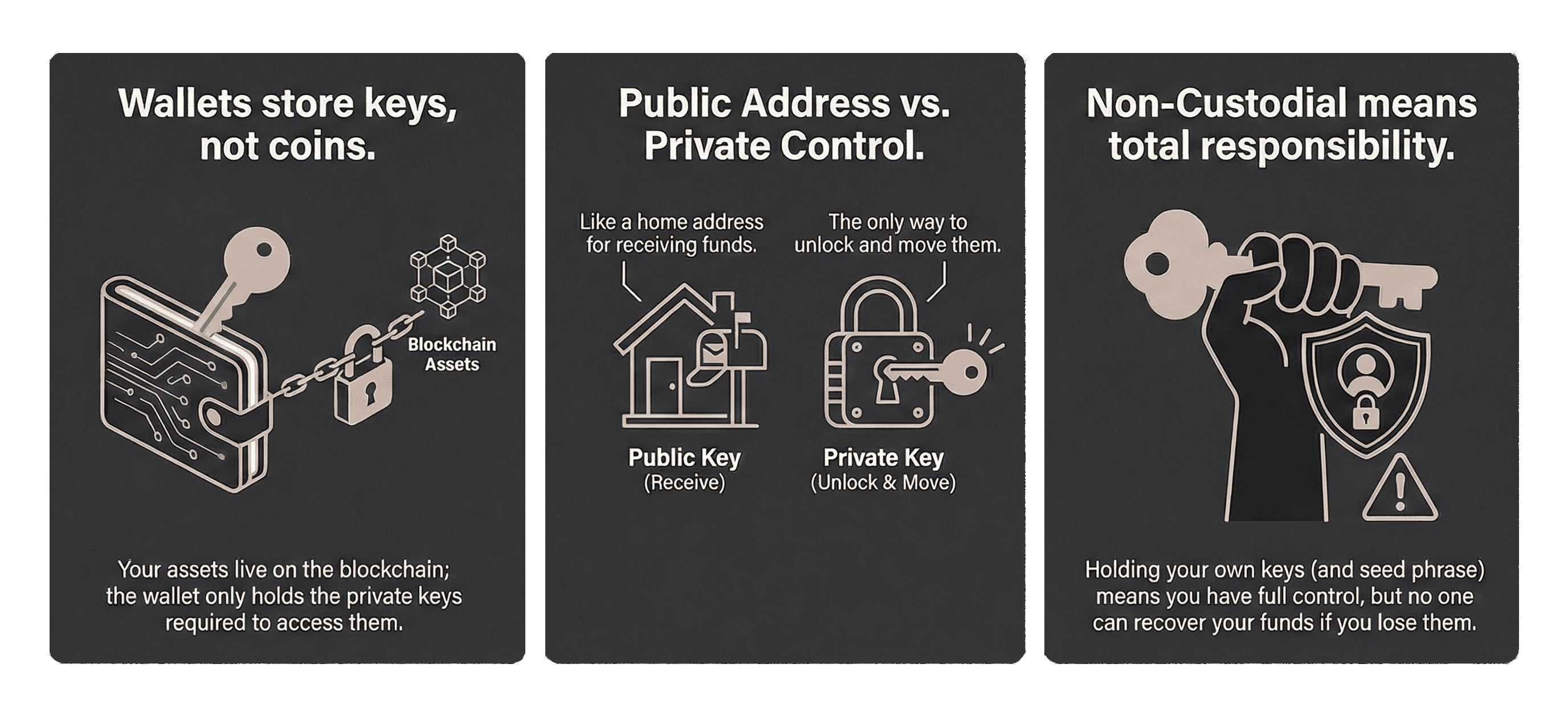
A crypto wallet doesn't store your cryptocurrency. Your digital assets live on the blockchain itself. Always. A wallet stores something else: the private keys that prove you own those assets.
Think of it like this: your cryptocurrency is a house on a public street. Everyone can see the house exists. But only the person with the correct key can unlock the door and access what's inside. Your wallet holds that key.
Public Keys and Private Keys
Every wallet has two components: a public key and a private key.
The public key is like your home address. You can share it freely. People need it to send you cryptocurrency. It's visible on the blockchain and anyone can look it up.
The private key is different. This is what actually controls your assets. Anyone with your private key can move your cryptocurrency anywhere they want. Lose your private key and you lose access to your assets forever.
Seed Phrases Explained
Most wallets generate what's called a seed phrase: twelve or twenty-four random words in a specific order. This phrase is a human-readable version of your private key.
Anyone with your seed phrase can recreate your private key and access your assets. This is why wallet setup always emphasizes: write down your seed phrase, store it securely and never share it with anyone. There's no password reset for blockchain. No customer service can recover lost keys.
Custodial vs Non-Custodial
Custodial wallets (like those provided by exchanges) store your private keys on their servers. You access your account with a username and password. It's more convenient but you're trusting the platform to secure your keys and give you access when you want it.
Non-custodial wallets put you in complete control. You hold the keys. You're responsible for security. Nobody can freeze your access or lose your funds on your behalf. But if you lose your keys, nobody can help you recover them.
The tradeoff is fundamental: convenience vs control.
Bridging the Gap
This is the challenge the industry faces: how do you maintain the security and ownership benefits of non-custodial wallets while removing the anxiety and complexity that stops most people from using them?
OROKAI approaches this through zero-setup wallet creation. The wallet is created on your device using smart contract or MPC architecture. Keys never touch our servers. We can't access your funds. You maintain complete ownership.
But you authenticate with familiar methods like email or biometrics instead of manually managing seed phrases. The technical complexity is abstracted away while the non-custodial architecture remains intact.
It's not about choosing between convenience and control. It's about building interfaces that provide both.
Ready to discover our interface? Join our waitlist to get early access.
Most people think a crypto wallet is like a physical wallet that holds money. You open it and your Bitcoin or Ethereum is sitting there. When you send cryptocurrency to someone, it moves from your wallet to theirs.
None of that is true.
Understanding how crypto wallets actually work requires rethinking what "having" cryptocurrency means. Your assets never sit in your wallet. They're not stored on your phone or computer. They exist on the blockchain itself, visible to everyone and controlled by mathematical proofs rather than physical possession.
So what does a wallet actually do?
What a Wallet Really Is
A crypto wallet doesn't store your cryptocurrency. Your digital assets live on the blockchain itself. Always. A wallet stores something else: the private keys that prove you own those assets.
Think of it like this: your cryptocurrency is a house on a public street. Everyone can see the house exists. But only the person with the correct key can unlock the door and access what's inside. Your wallet holds that key.
Public Keys and Private Keys
Every wallet has two components: a public key and a private key.
The public key is like your home address. You can share it freely. People need it to send you cryptocurrency. It's visible on the blockchain and anyone can look it up.
The private key is different. This is what actually controls your assets. Anyone with your private key can move your cryptocurrency anywhere they want. Lose your private key and you lose access to your assets forever.
Seed Phrases Explained
Most wallets generate what's called a seed phrase: twelve or twenty-four random words in a specific order. This phrase is a human-readable version of your private key.
Anyone with your seed phrase can recreate your private key and access your assets. This is why wallet setup always emphasizes: write down your seed phrase, store it securely and never share it with anyone. There's no password reset for blockchain. No customer service can recover lost keys.
Custodial vs Non-Custodial
Custodial wallets (like those provided by exchanges) store your private keys on their servers. You access your account with a username and password. It's more convenient but you're trusting the platform to secure your keys and give you access when you want it.
Non-custodial wallets put you in complete control. You hold the keys. You're responsible for security. Nobody can freeze your access or lose your funds on your behalf. But if you lose your keys, nobody can help you recover them.
The tradeoff is fundamental: convenience vs control.
Bridging the Gap
This is the challenge the industry faces: how do you maintain the security and ownership benefits of non-custodial wallets while removing the anxiety and complexity that stops most people from using them?
OROKAI approaches this through zero-setup wallet creation. The wallet is created on your device using smart contract or MPC architecture. Keys never touch our servers. We can't access your funds. You maintain complete ownership.
But you authenticate with familiar methods like email or biometrics instead of manually managing seed phrases. The technical complexity is abstracted away while the non-custodial architecture remains intact.
It's not about choosing between convenience and control. It's about building interfaces that provide both.
Ready to discover our interface? Join our waitlist to get early access.