/
Whitepaper
/
Problem
Simple UX
Why DeFi still lacks the kind of unified, friction-free experience that drove mass adoption in email, payments, and ride-hailing — and what that abstraction layer needs to look like for DeFi to cross the mainstream threshold.
The Missing Unified Experience
Lack of a cohesive and compliant "fiat-to-strategy" path
On-ramp, network selection, allocation, monitoring, claiming, and potential migration – today fragmented across different tools and interfaces.
Lack of parameter normalization
Users need comparable data (e.g., expected risk profile, fees, payout schedules), not jargon specific to each protocol.
Lack of predictable settlement
For a broad audience, settlement in a stable unit (e.g., USDT) is more understandable – but today this requires additional steps (swaps) and awareness of DEX costs and risks.
Historical analogies: Other industries solved this problem
DeFi in 2025 resembles other technologies at the moment BEFORE their mass adoption:
1. Email in the 90s vs. Gmail
90s (Pre-Gmail) | Gmail Era | DeFi Analogy |
|---|---|---|
Must configure POP3/SMTP server | One account, works everywhere | Today: Must understand RPC nodes, gas, keys |
Each provider has different interface | Unified UX | Today: Each protocol has different UI/UX |
Spam without filters | AI filtering | Today: No AI decision support |
"Dial-up" delays | Instant | Today: "Pending" transactions, bridge delays |
Result: Gmail led to mass email adoption (from ~100M to 1.8B users in 10 years)
2. E-commerce before Stripe (2011)
Before Stripe | After Stripe | DeFi Analogy |
|---|---|---|
Must integrate payment gateway (2-6 months) | 7 lines of code | Today: Must integrate each protocol separately |
Different standards per country | One API, 135+ countries | Today: Different standards per blockchain |
Compliance per jurisdiction (manual PCI DSS) | Stripe handles it | Today: Must understand regulations yourself |
Costly fiat settlements | Automatic | Today: Manual crypto→fiat conversion |
Result: Stripe enabled millions of small businesses to accept online payments
3. Uber vs. calling a taxi (2009)
Traditional taxi | Uber | DeFi Analogy |
|---|---|---|
Don't know who will come | Driver profile, ratings | Today: Don't know if protocol is safe (hidden audits) |
Don't know price upfront | Price before ride | Today: Gas fee surprise after transaction |
Cash, payment problems | Automatic card | Today: Must have ETH for gas, even for USDC swap |
Call, wait, no ETA | Real-time tracking | Today: "Pending" without clear status |
Result: Uber reduced "friction" from ~15 min to ~2 min → 150M+ users
Where is the "Stripe/Gmail/Uber for DeFi"?
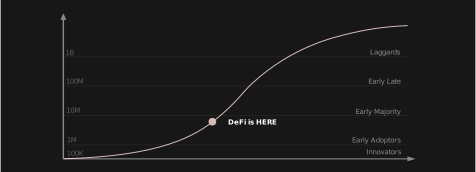
Key question: How to cross the "chasm" between Early Adopters (7M DeFi users) and Early Majority (10M+)?
Answer: An abstraction layer is needed that:
Hides technical complexity (like Gmail hid SMTP/POP3)
Standardizes experience (like Stripe unified payments)
Shows costs upfront (like Uber shows price before ride)
Maintains user control (here DeFi is BETTER than Web2 – self-custody)
OROKAI = that abstraction layer.
Consequence
Lack of an easy, comprehensible "one-stop" experience that guides users through the entire cycle while maintaining self-custody, DEX-first approach, and cost/risk transparency.
What These Problems Means for OROKAI
Technical layer abstraction Abstract wallet management, gas, and bridges while maintaining full user control and clear permissions (least-privilege).
Metric and warning normalization Common language for comparing strategies and uniform risk messaging.
Step-by-step guidance A path from on-ramp to allocation and potential claim/rebalancing, with clear costs before signing transactions.
USDT settlement (optional) Simplify understanding of results, while maintaining information that returns are variable and not guaranteed, and conversions occur through DEX with user consent.
AI module as informational assistant Reduces decision paralysis but does not provide investment advice.