
Analysis
The High Cost of Early DeFi: A History of Gas Fees
Ethereum gas fees were once the clearest economic barrier to DeFi participation, especially during periods when a simple on-chain action could cost tens of dollars and complex strategies could cost hundreds.
That framing still matters, but the current market structure is different enough that the topic now needs to be explained.
What Gas Fees Actually Measure
Gas is the pricing mechanism for computation on Ethereum rather than a flat platform fee, which means users are paying for the network resources consumed by their transactions. A basic ETH transfer consumes much less computational work than a smart-contract-heavy action such as a token swap, multi-step lending loop, or NFT mint, so transaction cost depends both on gas used and on current gas price conditions.
That distinction is essential in DeFi analysis because average network fee statistics can obscure what users actually experience at the application layer.
If you are new to how gas works in practice, Orokai Academy — Module 2, Lesson 2 covers the mechanics in full.
The Peaks: When Gas Became a Barrier
The first modern break in fee affordability came during DeFi Summer in 2020, when rapid growth in yield farming and protocol experimentation pushed Ethereum into sustained congestion. The problem intensified during the NFT boom and later speculative waves, when users regularly faced fees high enough to make smaller positions economically irrational.
The larger analytical point is not simply that fees were high, but that they changed who could participate. When transaction costs rise into double- or triple-digit dollar ranges, fixed costs begin to dominate expected returns for smaller accounts, which effectively reserves many DeFi strategies for larger capital pools.
The Turning Points
Three developments changed the trajectory.
EIP-1559, activated in August 2021, changed fee formation by introducing a base fee mechanism and fee burning, improving predictability even though it did not by itself solve the throughput constraint. The Merge in September 2022 reduced Ethereum’s energy consumption by more than 99 percent and provided architectural continuity for subsequent scaling upgrades, but it did not directly lower user transaction fees on its own.
The more direct break with the old fee regime came from Layer 2 adoption and EIP-4844 in March 2024, which introduced blob-based data handling for rollups and significantly reduced the cost basis for many L2 transactions. For end users, that meant the relevant question shifted from “Can DeFi be used at all?” to “Which execution layer makes a given strategy economically viable?”
Where Fees Stand Today
Current fee conditions are dramatically below earlier peak eras, but they are not uniform across the stack.
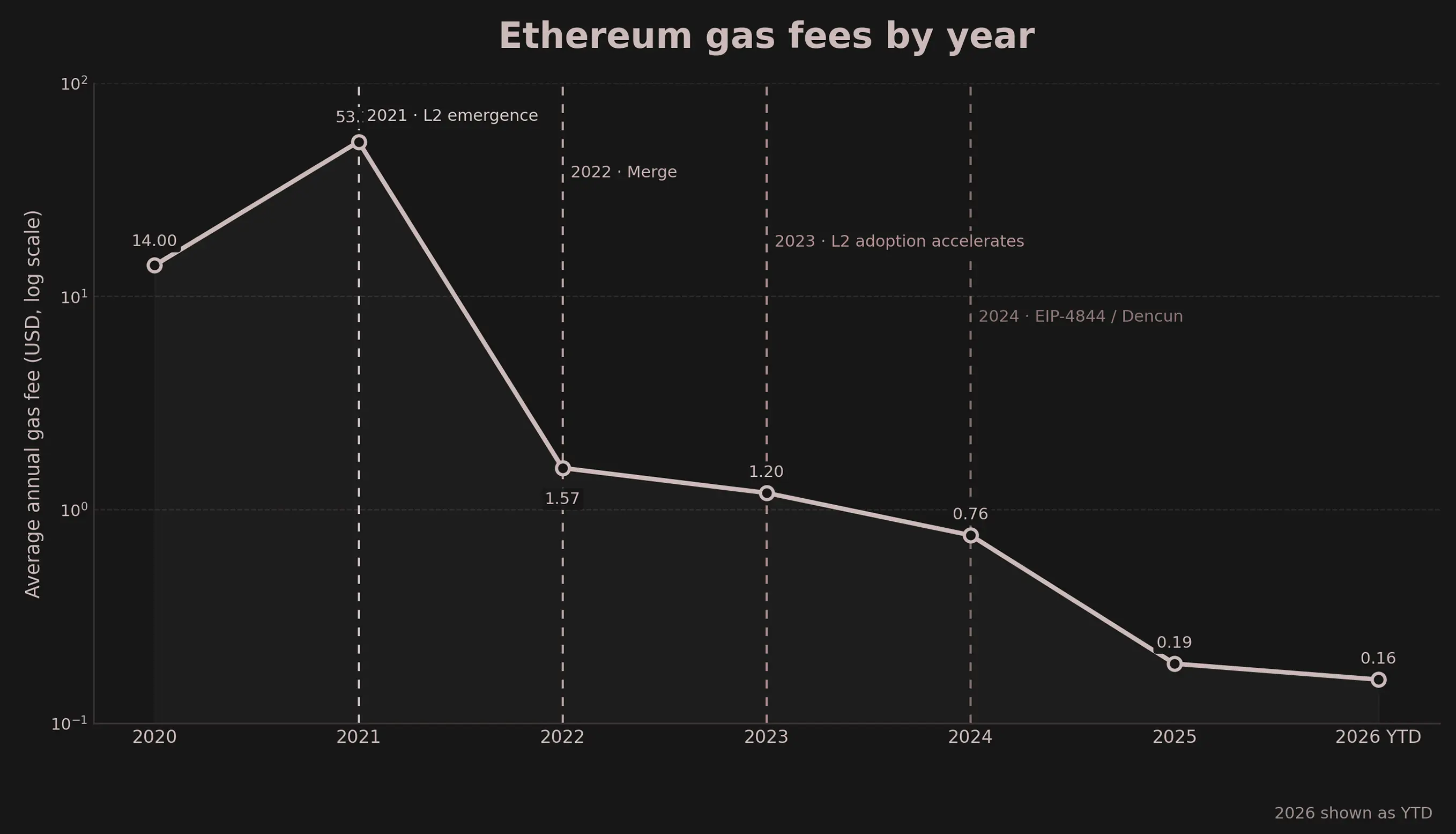
Broader network-level reporting shows how far fees have fallen from prior extremes: market coverage in 2025 described Ethereum transaction fees near five-year lows around $0.168 on average, and some 2026 reporting characterized the old “$50 gas era” as largely over outside exceptional congestion windows. This is the key newsroom framing: high fees are no longer the default state of Ethereum usage, but fee sensitivity still matters on mainnet and remains strategy-dependent
Statistics snapshot
Metric | Historical / current reading | Interpretation |
|---|---|---|
Average fee during earlier high-fee regime | 53.07 USD in a historical spike cited for November 2017 | Shows how quickly mainnet costs can become exclusionary in speculative demand surges. |
Average fee at 2025 low | 0.168 USD | Confirms that mainnet fee conditions can compress dramatically in weaker-demand environments. |
Typical L2 simple action | About 0.01–0.10 USD in the article’s framing, consistent with post-4844 compression narrative | Indicates that cost relief is increasingly structural at the rollup layer rather than purely cyclical on mainnet. |
Fee logic | Fees vary by gas used and network demand | Average fee claims should always be paired with transaction type. |
What This Means for DeFi Access
Ethereum’s gas market has evolved from a generalized affordability crisis into a layered pricing system in which cost depends on both congestion and execution venue. Historically, gas fees imposed a binding constraint on retail DeFi participation during demand spikes, especially when speculative cycles in DeFi and NFTs pushed mainnet usage beyond available capacity.
Three developments altered that structure. EIP-1559 improved fee predictability; the Merge reduced network energy intensity and supported long-term scaling architecture; and EIP-4844 lowered the data cost structure for rollups, enabling a sustained decline in end-user fees on Layer 2 networks.
As a result, a contemporary assessment of DeFi accessibility should not rely on legacy examples from the peak-fee era without current comparisons. Mainnet costs remain relevant, especially for complex smart-contract interactions, but the practical affordability frontier for many users has shifted toward L2 environments where transaction costs are often small enough to preserve the viability of lower-value positions and more frequent portfolio adjustments.
FAQ: The High Cost of Early DeFi: A History of Gas Fees
Why were Ethereum gas fees so high in 2020 and 2021?
Ethereum's block space is limited. During DeFi Summer 2020 and the NFT boom of 2021, demand for that space far exceeded capacity — creating a fee auction where users competed to have transactions processed. At peak congestion, simple transfers cost $50 and complex DeFi operations exceeded $200 in fees alone.
What caused gas fees to drop on Layer 2 networks?
EIP-4844, implemented in March 2024, introduced a new data storage format specifically designed for Layer 2 rollups. It reduced the cost of posting transaction data to Ethereum mainnet by 80–90% almost immediately — bringing L2 transaction costs from dollars to fractions of a cent on networks like Arbitrum, Optimism, and Base.