
Core Knowledge Basic
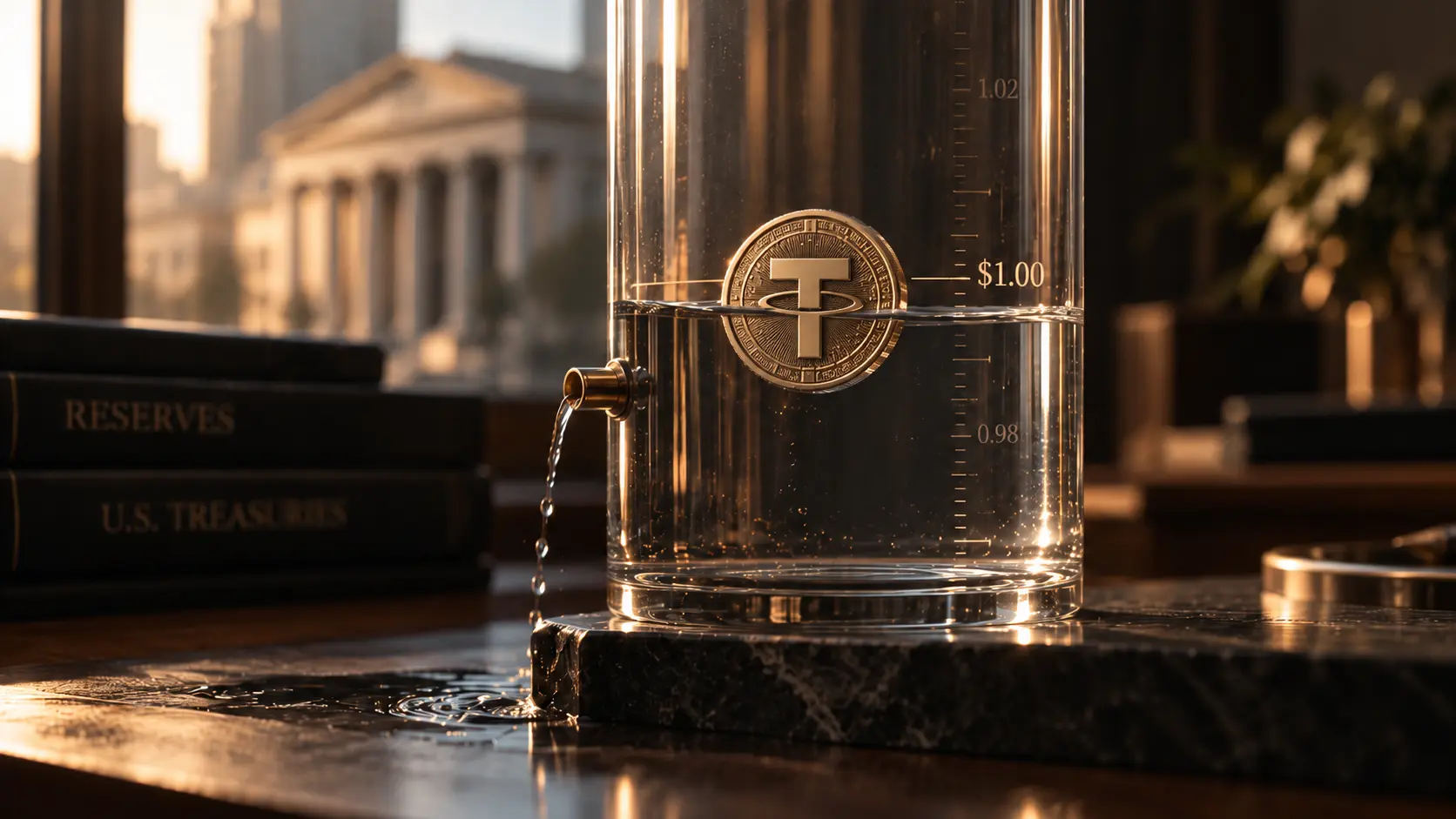
What Keeps a Stablecoin at One Dollar
On the weekend of March 11, 2023, people holding USDC woke up to find their digital dollars trading at around 87 cents. Nothing had been hacked. No code had failed. Circle, the company behind USDC, had disclosed that $3.3 billion of its reserves were sitting at Silicon Valley Bank, which had collapsed two days earlier.
By Monday the price was back at a dollar. That weekend shows exactly where the "stable" part comes from. It doesn't come from the blockchain. It comes from whatever sits behind the token, and from whether people believe they can swap one for the other.
A stablecoin is a claim on something else
A stablecoin is a token designed to hold a fixed value, usually one US dollar. The token itself is just an entry on a blockchain. Nothing in that entry forces its price to be $1.
What holds the price in place is a mechanism outside the token. There are a few different mechanisms, and they fail in very different ways. Knowing which one you're holding tells you more than the stablecoin's name ever will.
Backed by cash and government debt
The most widely used stablecoins, like USDC and USDT, are backed by reserves held by a company: cash in bank accounts and short term US government debt.
The peg works through redemption. Approved customers can hand the issuer one dollar and receive one token, or hand back one token and receive one dollar. That two way door is what keeps the market price close to $1.
If USDC trades at 99 cents on an exchange, a trader can buy it there and redeem it with Circle for a full dollar, keeping the difference. All that buying pushes the price back up. If it trades at $1.01, the trade runs in reverse. This is called arbitrage, and it's the quiet engine behind almost every stable price you see.
The weak point is the reserves. The token is only as good as the assets behind it. In March 2023, nobody was asking whether the code worked. They were asking whether $3.3 billion was gone. Once US authorities guaranteed SVB deposits, the answer was clear and the price snapped back.
One more detail many holders miss: the issuer can usually freeze tokens at a specific address. Circle and Tether both do this, typically in response to law enforcement requests or reports of stolen funds.
Backed by other crypto
A second design skips the bank entirely. DAI is the best known example. Users lock crypto such as ETH in a smart contract and borrow newly created stablecoins against it.
Because ETH can drop fast, the system demands more collateral than the stablecoins it issues. You might lock $150 of ETH to borrow $100 of stablecoins. This is called overcollateralization.
If ETH falls and a position gets too thin, the protocol sells the collateral automatically to cover the debt. That's a liquidation. It's painful for the borrower, but it's what keeps every outstanding stablecoin fully backed.
The risks don't disappear here. They move. Instead of trusting a bank account, you're trusting smart contract code, the price feeds (called oracles) that tell the contract what ETH is worth, and the assumption that liquidations can happen quickly enough during a crash. Many of these systems also hold fiat backed stablecoins like USDC as part of their reserves, which quietly brings some of the first design's risk along with it.
Backed by incentives alone
The third design tried to hold a peg with no reserves at all, relying on a second token and a set of rules instead. TerraUSD (UST) was the famous example. Holders could always swap 1 UST for $1 worth of its sister token, LUNA.
That works while people trust LUNA. In May 2022, heavy selling pushed UST below $1. Holders redeemed UST for freshly minted LUNA and sold it, which crushed LUNA's price, which made each redemption worth less, which triggered more selling. Within days both tokens were close to worthless, and tens of billions of dollars in value had vanished.
A peg defended only by a token whose value depends on that same peg has nothing to fall back on once confidence breaks.
What self-custody covers, and what it doesn't
This is where stablecoins connect to how you hold your assets. When you keep USDC in a self-custody wallet, you control the keys. No exchange can lock you out, freeze withdrawals during a crisis, or lose your funds in its own bankruptcy. That protection is real, and it's covered in more depth in What Self-Custody Really Means.
But self-custody protects your access to the token. It doesn't change what stands behind it. If an issuer's reserves take a hit, your token's price moves no matter which wallet it sits in. If the issuer freezes your address, your wallet still shows the balance, but you can't move it.
Owning your keys removes one layer of risk. The issuer's promise is a separate layer, and that one stays with you wherever the token goes.
Four questions to ask before holding a stablecoin
What backs it? Cash and government debt, other crypto, or nothing but incentives. Each answer points to a different way it could fail.
Who can redeem, and how quickly? A peg is only as strong as the path back to the dollar. If only large institutions can redeem, small dips can take longer to close.
How is the backing verified? For fiat backed coins, look for regular reserve reports from a named accounting firm. For crypto backed coins, the collateral is visible onchain, so check how much buffer the system actually holds.
Can it be frozen? Most fiat backed stablecoins can. Decide whether that's acceptable for how you use it.
For the bigger picture on how these risks fit into a portfolio, see Understanding Risk in Digital Assets.
FAQ: What Keeps a Stablecoin at One Dollar
Is holding a stablecoin the same as holding dollars in a bank?
No. Bank deposits in many countries are covered by government deposit insurance up to a limit. Stablecoins are not. When you hold a fiat backed stablecoin, you hold a claim on the issuer's reserves, so your safety depends on how those reserves are managed. Newer rules in the US and the EU set requirements for how issuers hold and report reserves, which reduces some risk, but it still isn't the same protection a bank account carries.
Why does my stablecoin sometimes show $0.998 or $1.002 instead of exactly $1?
Small gaps like these are normal. Trading fees, redemption costs and uneven liquidity across exchanges mean the price rarely sits at exactly $1.000. Arbitrage only kicks in when the gap is large enough to be worth the effort. A tiny wobble is routine. A gap of several cents that lasts for hours is a sign the market is questioning the backing.